
Pakistan is experiencing rapid industrialization, modernization of agricultural irrigation systems, and intensive...
Latest posts
-
 Advanced Flow Measurement Solutions in Pakistan: Industrial, Agricultural, and Commercial ApplicationsRead more
 -
 Pressure Transmitter Price in Pakistan: Complete Buying Guide, Types, Brands, Accuracy, Range & ApplicationsRead more
If you are searching for pressure transmitter price in Pakistan, the first thing to understand is that there is no...
-
 Pakistan Ki Process Industries Me Commercial & Industrial Valves: Ultimate Engineering & Procurement GuideRead more
Industrial flow control systems represent the lifeblood of modern process engineering. Across Pakistan's rapidly...
-
 7 Steps Me Industrial Pressure Gauge Select Karein: Ultimate Engineering GuideRead more
In any industrial processing plant, manufacturing facility, or automation loop, pressure is one of the most critical...
Blog categories
Search in blog
Archived posts
Pakistan Ki Process Industries Me Commercial & Industrial Valves: Ultimate Engineering & Procurement Guide
Industrial flow control systems represent the lifeblood of modern process engineering. Across Pakistan's rapidly evolving industrial landscape—ranging from the massive textile complexes in Faisalabad and Lahore, fertilizer plants in Rahim Yar Khan and Sheikhupura, to oil refineries and chemical facilities in Karachi—valves regulate, direct, isolate, and control the flow of steam, hydrocarbons, aggressive chemicals, water, and compressed air.
Selecting the correct industrial valve is not merely a matter of piping design; it directly dictates plant safety, thermal efficiency, fugitive emissions, and overall operational expenditure. Operating under extreme pressure differentials, high thermal cycles, and corrosive fluids, a misplaced or under-specified valve leads to rapid erosion, cavitation, fluid loss, and catastrophic process downtime.
This long-form technical guide provides process engineers, plant maintenance leads, and procurement teams across Pakistan with an exhaustive breakdown of the most commonly used industrial valves, international manufacturing standards, material selection criteria, and maintenance best practices.
1. Primary Classes of Industrial Valves Used in Pakistan
Industrial valves are broadly categorized based on their mechanical movement (linear or rotary) and their primary function (isolation, throttling, or backflow prevention).
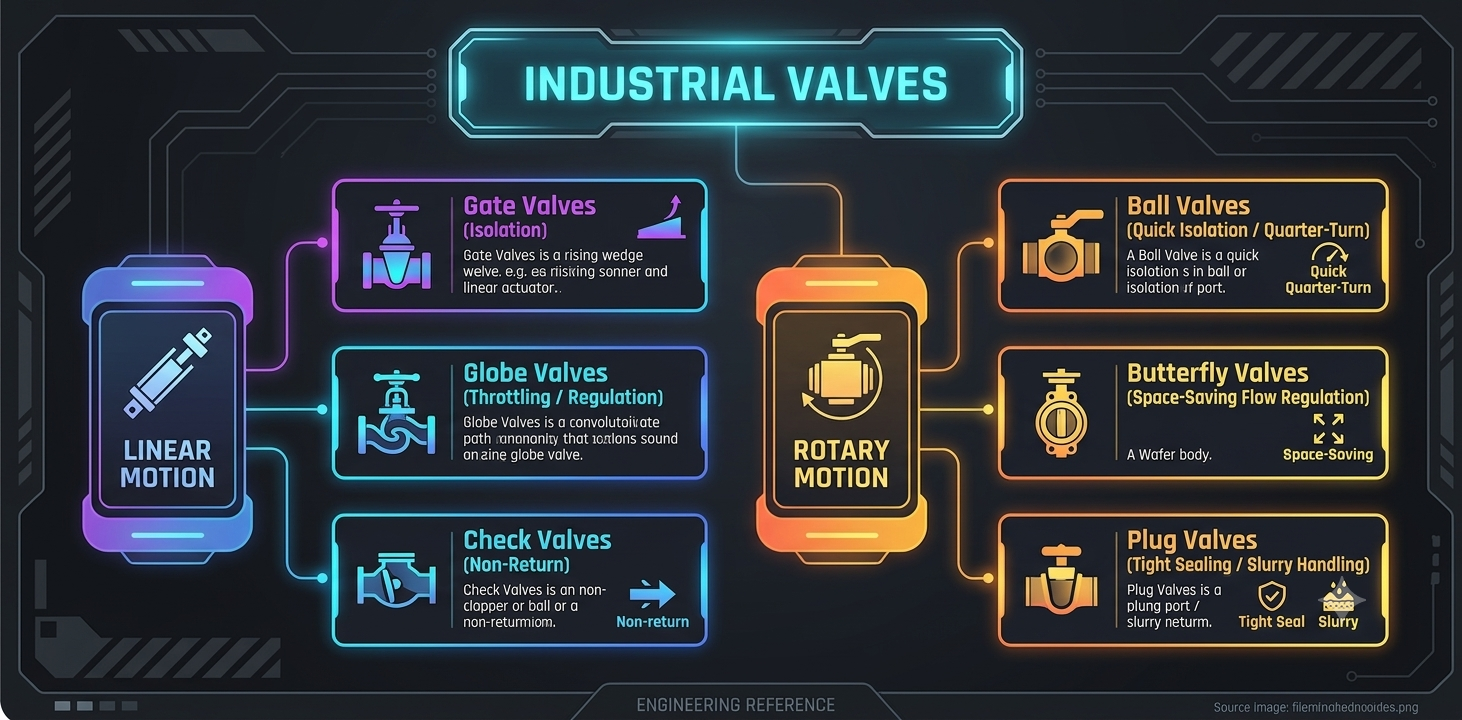
2. Deep-Dive Analysis of the Most Common Valve Types
1. Ball Valves: High-Performance Quarter-Turn Isolation
Ball valves feature a spherical closure element (the ball) with a precision-drilled bore running through its center. Rotating the valve stem by 90 degree aligns or blocks the bore with the flow path.
Structural Variations & Mechanics
· Floating Ball Valves: The ball is held suspended between two elastomeric or metallic seats. Fluid line pressure forces the ball against the downstream seat to achieve a bubble-tight seal. Ideal for low-to-medium pressure utility lines.
· Trunnion-Mounted Ball Valves: The ball is anchored at the top and bottom by trunnion shafts. The seat rings are spring-loaded and move against the ball. Essential for large-diameter, high-pressure pipelines (ANSI Class 600# to 2500#) where operating torque must remain low.
· Port Configurations: Full Port (unrestricted flow matching pipe internal diameter, ideal for pigging operations) and Reduced Port (standard port, economical for general utility lines).
Material & Operational Specs
· Body Materials: Cast Carbon Steel (ASTM A216 WCB), Forged Carbon Steel (ASTM A105), Stainless Steel (ASTM A351 CF8M / SS316).
· Seat Materials: PTFE, Reinforced PTFE (R-PTFE), PEEK (for high-temperature/high-pressure services), and Metal-to-Metal seats (for abrasive slurries).
· Primary Applications in Pakistan: Compressed air distribution lines, natural gas transmission (SNGPL / SSGC networks), chemical batching systems, and solvent transfer lines.
Explore PAKCIA’s Complete Range of High-Pressure Industrial Ball Valves
2. Gate Valves: Heavy-Duty On/Off Pipeline Isolation
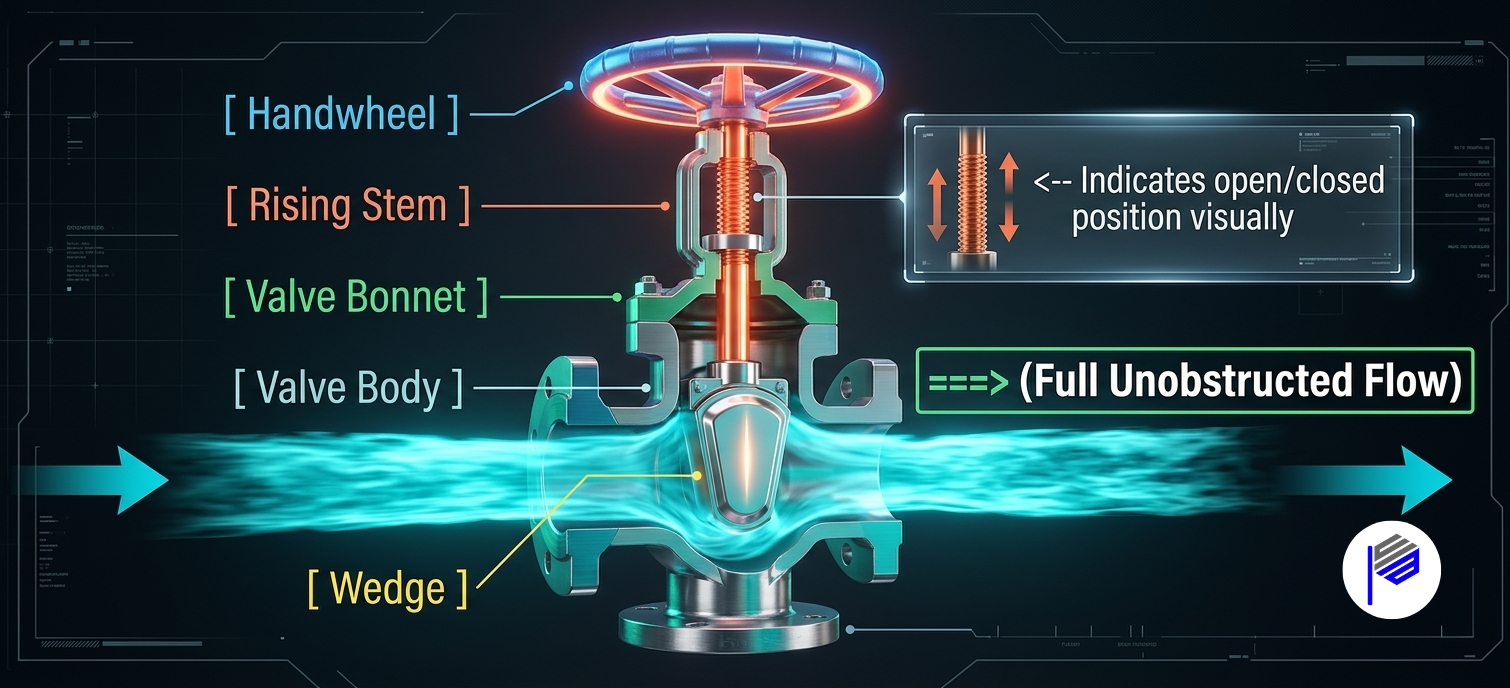
Gate valves use a linear sliding wedge or disc that moves vertically into the flow stream. They are intended exclusively for fully open or fully closed service. Never use a gate valve for flow throttling, as high-velocity fluid passing a partially open wedge causes intense vibration, seat erosion, and chatter.
Key Design Variations
· Solid Wedge Gate Valves: Simple, robust design with single-piece construction. Preferred for general utility services and low-pressure steam.
· Flexible Wedge Gate Valves: Features a cut around the perimeter to allow the seating surfaces to flex independently, overcoming thermal binding in high-temperature steam lines.
· OS&Y (Outside Screw and Yoke): The stem threads remain outside the fluid medium, protecting them from corrosion and elevated temperatures while serving as an instant visual indicator of valve position.
Specifications & Standards
· Manufacturing Standards: API 600 (Cast Steel Gate Valves) and API 602 (Forged Steel Gate Valves).
· Pressure Classes: ANSI Class 150#, 300#, 600#, 900#, 1500#, and 2500#.
· Primary Applications in Pakistan: Main steam headers in sugar mills, crude oil distribution manifolds, power generation utility lines, and raw water intake infrastructure.
Browse Heavy-Duty API 600 / API 602 Gate Valves at PAKCIA
3. Globe Valves: Precision Flow Throttling & Pressure Regulation
Unlike gate valves, globe valves are engineered specifically to regulate and throttle fluid flow. Fluid enters the valve body, changes direction by 90 degree through an internal baffle, and passes through an orifice controlled by a moveable plug.
Structural Styles
· T-Pattern (Standard): Lowest cost, highest pressure drop.
· Y-Pattern: The stem and seat are angled at 45 degree, reducing pressure drop while preserving excellent throttling precision. Ideal for high-pressure steam blowdown service.
· Angle Pattern: Combines a 90 degree elbow and throttling valve into a single unit, eliminating an extra pipe fitting in tight boiler plants.
Primary Applications in Pakistan
Boiler feedwater lines, steam pressure reduction stations (PRS), thermal oil heaters, and chemical dosing systems in pharmaceutical and textile manufacturing.
Check PAKCIA High-Temperature Globe Valves for Steam & Process Control
4. Butterfly Valves: Economical, Compact Large-Diameter Flow Control
Butterfly valves use a circular disc mounted on a central rotating shaft. As a quarter-turn rotary valve, turning the actuator 90 degree moves the disc from fully closed to fully open.
Wafer vs. Lug Body Types
· Wafer Style: Clamped directly between two pipe flanges using long stud bolts. Lightweight and economical, but cannot be disconnected from one side of the line for downstream maintenance without draining the system.
· Lug Style: Features threaded inserts (lugs) surrounding the body. Allows bolts to be threaded directly into the body from either side, enabling dead-end service and downstream line disassembly.
· Double-Flanged Style: Features traditional flanges on both ends; mandatory for large-diameter municipal water mains and heavy industrial cooling loops.
Offset Technologies
1. Zero-Offset (Resilient Seated): Rubber-lined body (EPDM, NBR, Viton) suitable for low-pressure water, air, and HVAC lines.
2. Double Offset (High-Performance): Disc is offset from the stem axis and body seat, minimizing friction during opening/closing. Used in steam and medium-pressure industrial systems.
3. Triple Offset (TOV): Features a third eccentric offset in the seat cone axis, enabling metal-to-metal bubble-tight sealing without friction. Essential for high-temperature, high-pressure hydrocarbon service.
Discover PAKCIA Wafer, Lug, and Triple-Offset Butterfly Valves
5. Check Valves: Automatic Non-Return & Backflow Prevention
Check valves are self-actuated safety devices that rely solely on fluid velocity and backpressure to operate. They prevent backflow that could damage pumps, compressors, and steam boilers.
Major Types
· Swing Check Valves: A hinged disc swings open with forward flow and snaps shut when flow drops or reverses. Excellent for low-velocity liquid lines.
· Dual-Plate Wafer Check Valves: Features two spring-loaded semi-circular plates. Highly compact design that minimizes water hammer in high-flow pumping systems.
· Piston / Lift Check Valves: Utilizes a guided piston that lifts off its seat via flow pressure. Recommended for high-pressure gas and steam applications where flow velocities fluctuate rapidly.
Buy Certified Swing & Dual-Plate Wafer Check Valves from PAKCIA
6. Solenoid & Electro-Pneumatic Control Valves: Plant Automation
As industries across Pakistan adopt Industry 4.0 and automated process control systems, solenoid valves and pneumatic control valves are replacing manual handwheel-operated valves.
Key Automated Technologies
· Direct-Acting Solenoid Valves: An electromagnetic coil directly lifts the plunger to open or close small-bore fluid lines within milliseconds.
· Pilot-Operated Solenoid Valves: Uses system fluid pressure to actuate the main diaphragm or piston, allowing small coils to control high-flow pipelines.
· Pneumatic Diaphragm Control Valves: Driven by instrument air (3-15 PSI or 4-20mA electro-pneumatic positioners) to provide linear, equal percentage, or quick-opening flow control in continuous processes.
Primary Applications in Pakistan
Textile dyeing machines, pharmaceutical batch reactors, automated bottling plants, compressed air dryers, and steam temperature control units.
Explore PAKCIA High-Performance Solenoid Valves
3. Industrial Sector Analysis: Valves Used in Pakistan
Different manufacturing sectors in Pakistan encounter distinct chemical environments, pressure profiles, and operational standards.
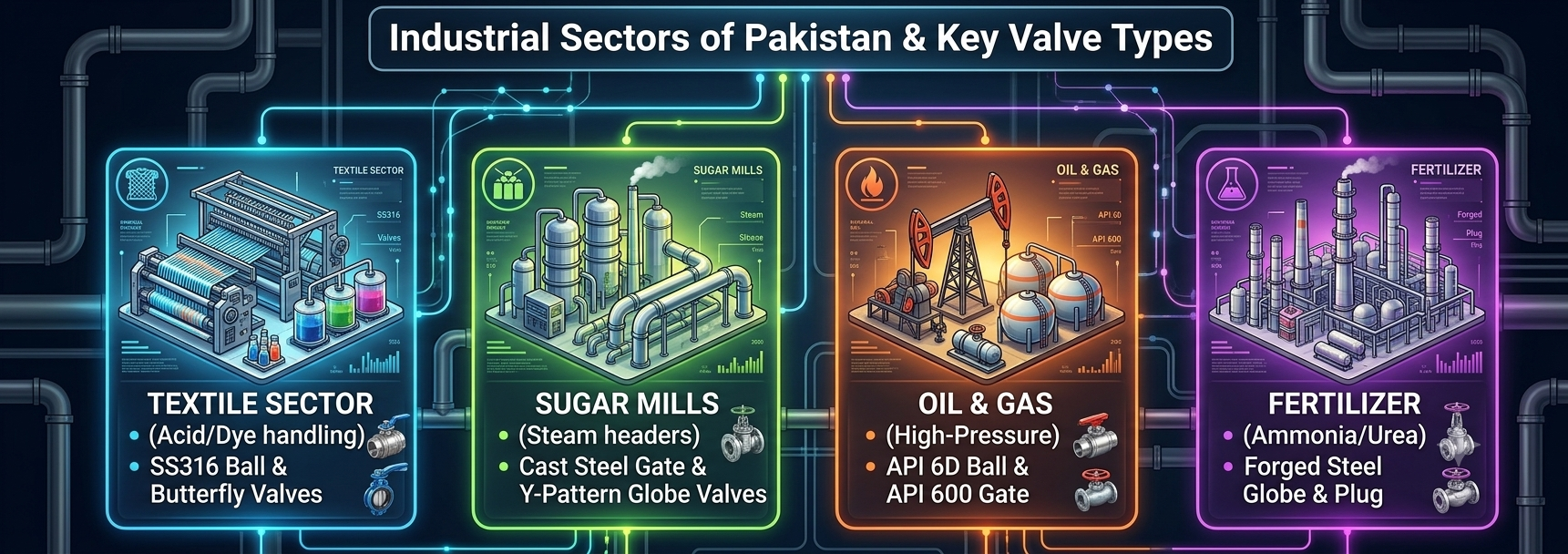
A. Textile & Dyeing Industry (Faisalabad, Lahore, Karachi)
· Operating Conditions: Abrasive dyes, acidic bleaching liquids, high-frequency thermal cycling, and continuous utility steam.
· Preferred Valves: Stainless Steel (SS316 / CF8M) ball valves with PTFE seats, resilient-seated wafer butterfly valves, and pneumatic angle-seat steam valves.
· Critical Factor: High corrosion resistance to prevent chemical contamination of fabric batches.
B. Sugar Mills & Power Generation (South Punjab, Sindh)
· Operating Conditions: High-pressure superheated steam (400 degree C+), thick sugarcane juice slurries, bagasse combustion lines, and boiler feedwater.
· Preferred Valves: OS&Y Cast Steel Gate Valves (API 600), Y-pattern globe valves, heavy-duty swing check valves, and metal-seated butterfly valves.
· Critical Factor: Resistance to thermal expansion binding and abrasive particle erosion.
C. Oil & Gas, Petrochemicals & Refineries (Karachi, Attock, Pak-Arab Pipeline)
· Operating Conditions: Highly flammable hydrocarbons, extreme pressure ratings (Class 600# to 2500#), and strict fugitive emission limits.
· Preferred Valves: Trunnion-mounted forged ball valves (API 6D), fire-safe certified gate and globe valves, and triple-offset butterfly valves.
· Critical Factor: NACE MR0175 compliance for sour gas (H2S) service and API 6FA / API 607 fire-safe certification.
D. Fertilizer & Chemical Processing (Multan, Sheikhupura, Machhi Goth)
· Operating Conditions: Highly toxic and corrosive fluids including synthesis gas, ammonia, urea melt, and nitric acid.
· Preferred Valves: High-alloy forged steel globe valves, fully lined plug valves (PTFE/PFA lined), and specialized bellows-seal valves that eliminate stem leakage completely.
Critical Factor: Zero fugitive emissions and high resistance to stress-corrosion cracking (SCC).
4. Engineering Standards & Specifications Matrix
Procurement managers must ensure that imported or locally sourced valves conform strictly to international engineering design standards. Mixing standards can result in misaligned flange bolt circles, improper face-to-face dimensions, or pressure rating failures.
Comparison: API vs. DIN vs. BS Standards
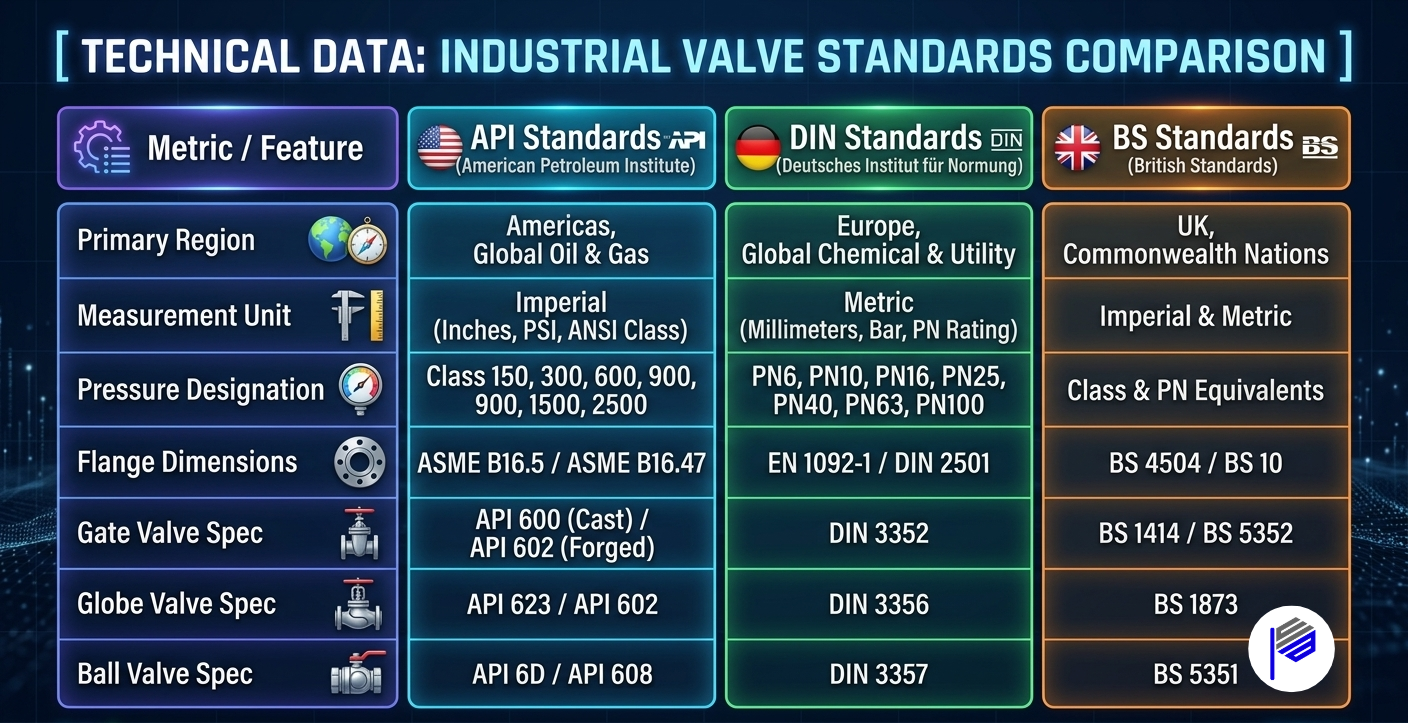
Crucial Engineering Rule: Never assume an ANSI Class 150# flange will bolt onto a DIN PN16 flange! Though both handle similar utility pressures (~16 to 20 bar), their bolt circle diameters (PCD), bolt hole counts, and overall flange thicknesses differ significantly.
5. Valve Material Selection Guide for Pakistani Operating Environments
The service life of an industrial valve depends directly on selecting body, trim, and packing materials capable of withstanding system media and atmospheric conditions across Pakistan.
Body Materials
1. Ductile Iron (ASTM A536 / GGG40): Excellent tensile strength and shock resistance. Cost-effective choice for low-pressure water treatment, HVAC, and non-corrosive utility systems up to 16 bar.
2. Cast Carbon Steel (ASTM A216 WCB): The standard workhorse material for oil, gas, steam, and general process media up to 400 degree C.
3. Forged Carbon Steel (ASTM A105): Superior structural density without casting porosity. Used for high-pressure, small-bore (1/2'' to 2'') valves up to Class 800# / 1500#.
4. Austenitic Stainless Steel (ASTM A351 CF8 / CF8M - SS304 / SS316): Provides high corrosion resistance against acids, chemical additives, dyes, and demineralized water. SS316 contains 2-3% Molybdenum, rendering it highly resistant to pitting corrosion in coastal environments like Karachi.
Valve Trim Materials (API Trim Numbers)
The "trim" comprises the internal wetted parts: stem, seating surfaces, disc, and backseats. API specifies standardized trim numbers to ensure proper material pairing:
· API Trim 1 (13% Chromium Steel): Standard trim for general non-corrosive oil, gas, and steam applications up to 370 degree C.
· API Trim 5 (Hardfaced Stellite 6): Extreme wear-resistant cobalt alloy overlay on seating surfaces. Essential for high-pressure, high-temperature steam blowdown and abrasive slurries.
· API Trim 8 (13% Cr / Hardfaced Seat): Standard heavy-duty industrial combination providing extended seat lifespan under continuous cycling.
· API Trim 10 (316 Stainless Steel): Selected for corrosive chemical process streams.
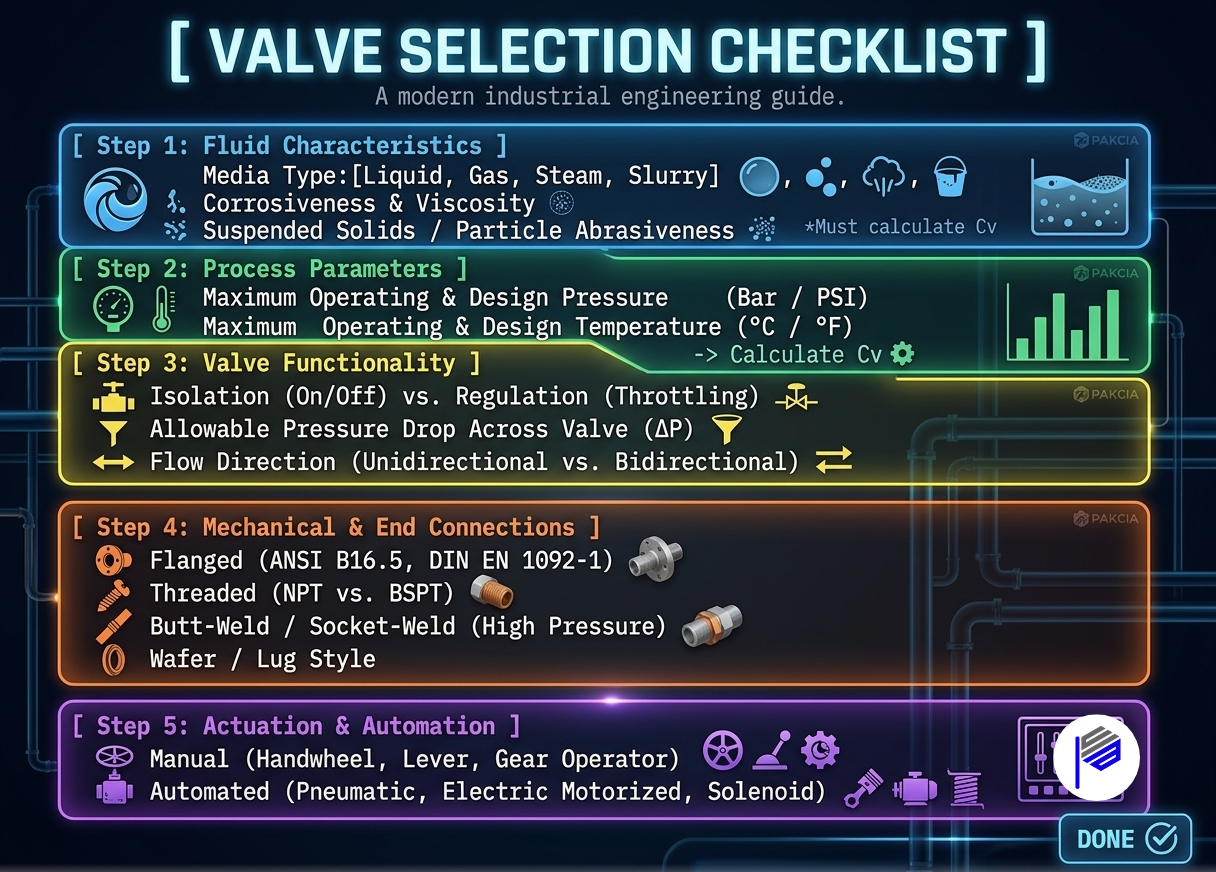
6. Step-by-Step Valve Selection Checklist for Plant Engineers
Before issuing a Purchase Requisition (PR) or Request for Quotation (RFQ), complete the following engineering evaluation:
7. Installation, Testing & Maintenance Best Practices
Even the highest quality valve will fail prematurely if improperly installed or neglected during routine shutdowns.
Pre-Installation Integrity Rules
1. Flange Alignment & Cleaning: Never draw misaligned pipe flanges together using valve flange bolts. This induces high bending stresses in the valve body, leading to seat distortion, binding, or casing cracks.
2. Pipeline Flushing: Prior to commissioning new or modified pipe spools, perform a thorough hydro-flush or air blowdown. Welding slag, pipe scale, and sand are the leading causes of immediate seat scarring in brand-new valves.
3. Correct Orientation: Always install check valves and globe valves following the flow arrow cast onto the outer valve body. Installing a globe valve in reverse alters throttling performance and strains stem packing.
Hydrostatic & Leak Testing Standards
All industrial valves supplied by reputable manufacturers must undergo factory acceptance testing in accordance with API 598 (Valve Inspection and Testing) or EN 12266-1:
· Shell Test: Hydrostatic pressure applied inside the closed valve body at 1.5X the rated working pressure to verify casing integrity.
· High-Pressure Closure Test: Testing the internal seat sealing at 1.1X the maximum rated pressure to confirm zero leakage or allowable drop rates based on API criteria.
· Low-Pressure Air Seat Test: Testing resilient seats at 80 PSI (5.5bar) air pressure to confirm bubble-tight sealing performance.
Preventative Maintenance Guidelines
· Stem Packing Adjustment: If gland packing leaks occur, tighten gland flange nuts evenly by a 1/4-turn at a time. Over-tightening increases stem friction torque and accelerates packing wear.
· Grease Injections: High-pressure ball and gate valves equipped with emergency sealant injection fittings should be lubricated periodically using synthetic valve greases compatible with line fluids.
· Periodic Stroking: Spare or isolation valves that remain open or closed for months should be periodically stroked (partially closed and reopened) during maintenance routines to prevent mineral scaling and stem freeze.
Conclusion: Source Reliable, Certified Industrial Valves in Pakistan
Choosing the right industrial valve requires a careful balance between fluid compatibility, pressure/temperature limits, international design standards, and life-cycle costs. Whether you are running a steam utility network in South Punjab, managing chemical feed lines in Karachi, or upgrading automated process control loops in Faisalabad, selecting certified, properly rated valves prevents unplanned downtime and safeguards plant personnel.
At PAKCIA, we provide a complete portfolio of high-performance industrial valves, instrumentation systems, and process automation components tailored to the needs of Pakistan's industrial sectors. Our technical team assists engineers with valve sizing calculations, material selection, standard cross-referencing, and nationwide delivery.
View All PAKCIA's Industrial Valves & Flow Control Mechanical Valves here.
Posted in:
Default category
Related posts
-
7 Steps Me Industrial Pressure Gauge Select Karein: Ultimate Engineering Guide
In any industrial processing plant, manufacturing facility, or automation loop, pressure is one of the most critical...Read more
-
Pressure Transmitter Price in Pakistan: Complete Buying Guide, Types, Brands, Accuracy, Range & Applications
If you are searching for pressure transmitter price in Pakistan, the first thing to understand is that there is no...Read more
-
Advanced Flow Measurement Solutions in Pakistan: Industrial, Agricultural, and Commercial Applications
Pakistan is experiencing rapid industrialization, modernization of agricultural irrigation systems, and intensive...Read more
Leave a comment