

Pakistan is experiencing rapid industrialization, modernization of agricultural irrigation systems, and intensive...

If you are searching for pressure transmitter price in Pakistan, the first thing to understand is that there is no single price for every pressure transmitter.
A pressure transmitter can cost significantly more or less depending on its pressure range, output signal, accuracy, sensing technology, process connection, wetted materials, temperature capability, brand, country of manufacture and application.
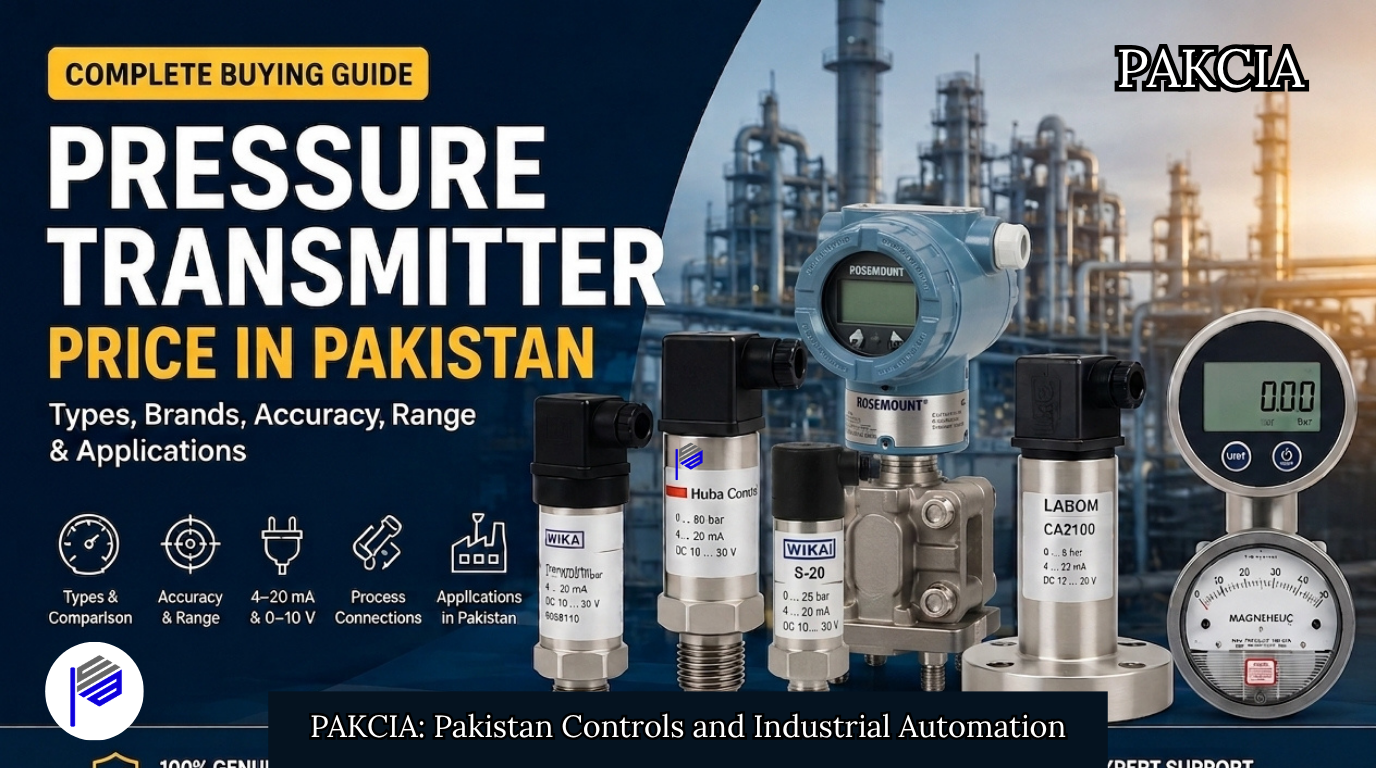
PAKCIA offers pressure measurement instruments from several international industrial brands, including WIKA, Huba Control, LABOM and ECKELMANN, along with pressure sensors, digital pressure gauges and differential pressure instruments.
A pressure transmitter should therefore never be selected based on price alone.
The correct question is:
Which pressure transmitter provides the required accuracy, pressure range, compatibility and signal for my application at the right total cost?
This complete guide explains what you need to know before buying a pressure transmitter in Pakistan.
What Is a Pressure Transmitter?
A pressure transmitter is an industrial measuring instrument that detects pressure in a liquid, gas or vapor and converts that pressure into an electrical output signal that can be transmitted to a control system.
The most common industrial output is 4–20 mA, although voltage outputs such as 0–10 V are also used in many automation systems.
A typical pressure measurement system works like this:
Process pressure → Sensing element → Electronic signal conversion → 4–20 mA / 0–10 V → PLC / DCS / SCADA
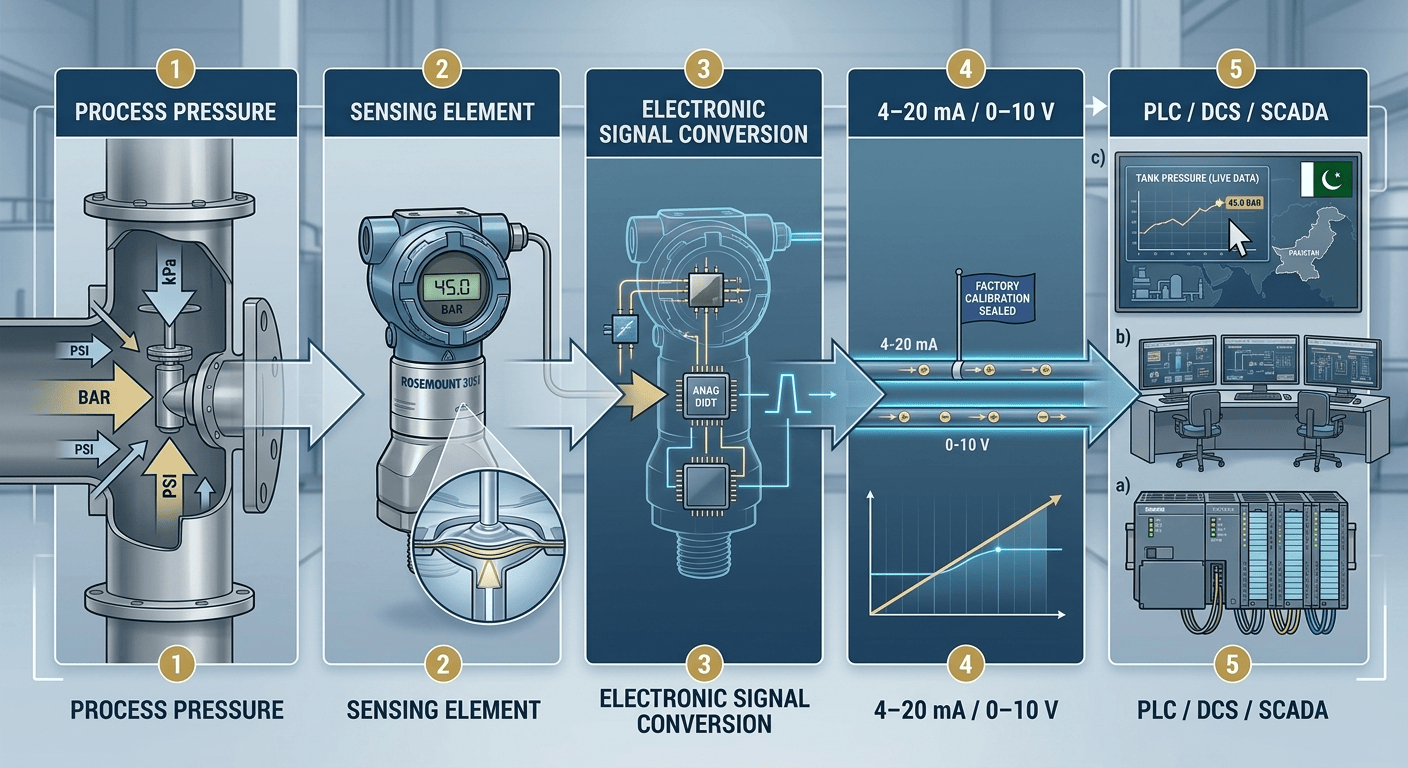
For example, a pressure transmitter installed on a water pipeline can continuously measure pressure and send the measurement to a PLC. The PLC can then display the pressure, generate an alarm or control a pump.
This is different from a conventional mechanical pressure gauge.
A pressure gauge provides a local visual reading, while a pressure transmitter provides an electrical measurement for monitoring, automation and control.
PAKCIA provides both industrial pressure transmitters and other pressure measurement instruments for applications where engineers need electronic transmission, local indication or differential pressure measurement.
Pressure Transmitter vs Pressure Gauge
| Feature | Pressure Transmitter | Pressure Gauge |
|---|---|---|
| Main purpose | Measurement and electronic transmission | Local visual indication |
| Output | 4–20 mA, 0–10 V etc. | Mechanical dial or digital display |
| PLC connection | Yes | Normally no |
| Remote monitoring | Yes | No |
| Automation | Excellent | Limited |
| Local indication | Depends on model | Yes |
| Typical applications | Process control, PLC, SCADA | Local monitoring and maintenance |
| Power supply | Usually required | Usually not required |
If you need to send pressure information to a PLC, a 4–20 mA pressure transmitter is normally more suitable.
If an operator simply needs to see the pressure beside a machine, a mechanical or digital pressure gauge may be sufficient.
Types of Pressure Transmitters
Pressure transmitters can be classified in several ways. Understanding these classifications is essential when selecting a transmitter.
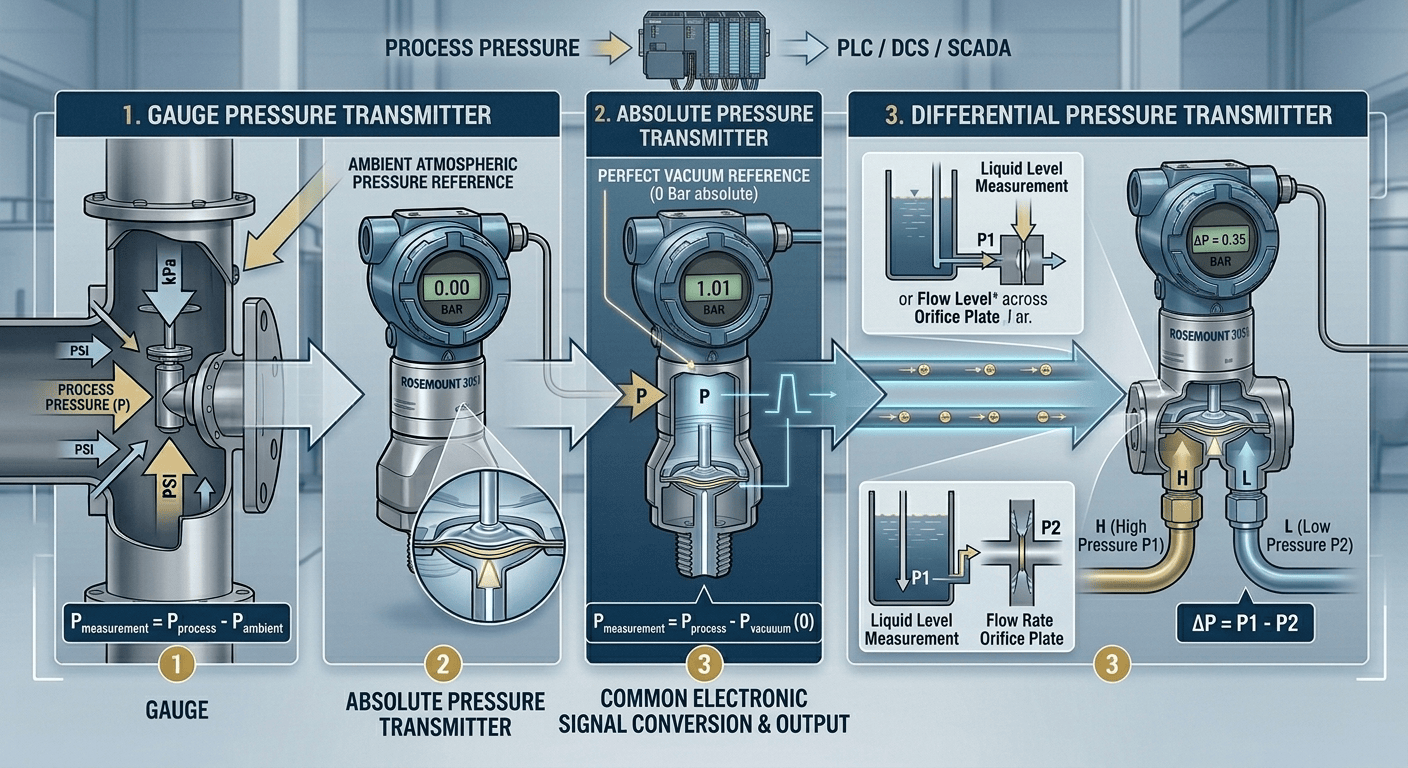
1. Gauge Pressure Transmitter
A gauge pressure transmitter measures pressure relative to atmospheric pressure.
It is commonly used for:
- Water pressure
- Compressed air
- Hydraulic systems
- Pumps
- Industrial machinery
- Process pipelines
- Boilers and utilities
For example, a 0–10 bar gauge pressure transmitter reads approximately 0 bar when the process pressure equals atmospheric pressure.
2. Absolute Pressure Transmitter
An absolute pressure transmitter measures pressure relative to a vacuum reference.
It is useful where atmospheric pressure variations should not affect the measurement.
Typical applications include:
- Vacuum systems
- Vacuum pumps
- Laboratory systems
- Process equipment
- Gas measurement
- Specialized industrial processes
The ECKELMANN 26 bar pressure transmitter is an example of a transmitter specified with an absolute pressure range of approximately 1–26 bar and a 4–20 mA output.
3. Differential Pressure Transmitter
A differential pressure transmitter measures the difference between two pressure points.
Instead of measuring pressure at only one point, it has two pressure connections, commonly called the high-pressure side and low-pressure side.
Differential pressure measurement is commonly used for:
- Filter monitoring
- Air handling systems
- HVAC
- Flow measurement
- Level measurement in closed tanks
- Industrial process control
For suitable low-pressure differential applications where local indication is required, the Dwyer Magnehelic Differential Pressure Gauge is another pressure measurement option available from PAKCIA.
4–20 mA Pressure Transmitters
If you work with industrial automation, you will frequently encounter 4–20 mA pressure transmitters.
A 4–20 mA transmitter represents the measured pressure using an electrical current.
| Pressure | Typical Output |
|---|---|
| 0 bar | 4 mA |
| 2.5 bar | 8 mA |
| 5 bar | 12 mA |
| 7.5 bar | 16 mA |
| 10 bar | 20 mA |
The exact scaling depends on the configured measurement range.
Advantages of 4–20 mA
- Good resistance to electrical interference
- Suitable for relatively long cable runs
- Easy integration with PLCs
- Easy fault detection
- Standard industrial automation signal
- Suitable for process control systems
PAKCIA offers multiple pressure transmitters using 4–20 mA output, including Huba Control, LABOM, ECKELMANN and LEEG models.
0–10 V Pressure Transmitters
Another common output is 0–10 V.
Unlike a current-loop transmitter, the output voltage changes according to the measured pressure.
PAKCIA offers the WIKA 1000 mbar pressure transmitter, which uses a 0–10 V output configuration.
A 0–10 V transmitter may be suitable when the receiving automation controller specifically expects a voltage signal.
Before purchasing, always check:
- PLC analog input type
- Input voltage range
- Cable length
- Electrical environment
- Required accuracy
- Power supply
Do not replace a 4–20 mA transmitter with a 0–10 V transmitter simply because the pressure range appears identical. The output signal must be compatible with the control system.
How to Select the Correct Pressure Range
Pressure range is one of the most important factors affecting pressure transmitter selection.
Suppose your process normally operates around 5 bar.
Choosing a transmitter with a 0–5 bar range may appear logical, but it can leave little margin for pressure spikes.
On the other hand, selecting a 0–100 bar transmitter for a 5 bar process can unnecessarily reduce the useful resolution of the measurement.
A good selection balances:
Normal operating pressure + expected pressure fluctuations + overpressure protection + required accuracy
Typical examples include:
- Water systems: 0–6 bar
- Industrial compressed air: 0–10 bar
- Hydraulic systems: 0–100 bar
- Higher-pressure hydraulic applications: 0–250 bar or more
The correct range must always be based on the actual process conditions and the manufacturer's specifications.
PAKCIA offers pressure transmitters across different ranges, including the LEEG pressure transmitter, Huba Control 60 bar transmitter, LABOM 16 bar pressure sensor and ECKELMANN 26 bar absolute pressure transmitter.
Pressure Transmitter Accuracy
Accuracy is another major factor affecting pressure transmitter price in Pakistan.
A transmitter with higher accuracy generally costs more because the sensing element, electronics, calibration and manufacturing requirements can be more demanding.
The LABOM CA2100, for example, is listed with an accuracy of ≤0.2% of measuring range.
But do not automatically buy the highest accuracy transmitter available.
Ask:
How much accuracy does my process actually require?
A general utility water system may not require the same measurement performance as a critical process-control loop or calibration application.
When comparing specifications, check whether the stated accuracy is expressed as:
- % of full scale
- % of span
- % of reading
- Typical accuracy
- Maximum error
These specifications are not always equivalent.
Process Connections
The pressure transmitter must physically connect to your process.
Common process connection types include:
- 1/4-inch
- 1/2-inch
- G / BSP
- NPT
- Threaded diaphragm connections
- Specialized process connections
PAKCIA products demonstrate why connection specification matters.
The ECKELMANN model uses a 1/4-inch thread, while the LABOM CA2100 uses a front-flush diaphragm connection.
Never assume that two transmitters with the same pressure range will automatically fit the same installation.
Before ordering, confirm:
Thread type + thread size + mounting arrangement + sealing method
Wetted Materials: Why They Matter
The term wetted parts refers to components that come into direct contact with the process medium.
Material compatibility is critical.
If a standard transmitter is installed on a process containing aggressive chemicals and the wetted material is not compatible with the medium, corrosion can cause:
- Leakage
- Measurement errors
- Premature failure
- Contamination
- Safety problems
Common materials include stainless steel and other specialized alloys depending on the application.
For viscous, contaminated or crystallizing media, a conventional pressure port can become blocked.
This is where a flush diaphragm pressure transmitter can be advantageous.
The LABOM CA2100 listed by PAKCIA uses a front-flush diaphragm design and is intended for applications involving viscous, crystallizing or contaminated media.
IP Rating and Environmental Protection
The transmitter may be installed in environments containing:
- Dust
- Moisture
- Water spray
- Humidity
- Oil
- Industrial contamination
The IP rating indicates the protection provided by the enclosure against solid particles and water according to the applicable rating system.
For example, the PAKCIA-listed LABOM CA2100 has an IP65 stainless-steel case.
However, IP rating is only one part of environmental suitability.
You should also consider:
- Ambient temperature
- Process temperature
- Vibration
- Chemical exposure
- Outdoor installation
- Cable entry
- Condensation
Temperature: Process and Ambient
Temperature is frequently overlooked when purchasing a pressure transmitter.
There are two different temperatures to consider:
Process Temperature
The temperature of the fluid, gas or vapor being measured.
Ambient Temperature
The temperature surrounding the transmitter.
A transmitter may have a different allowable temperature range for each.
This is particularly important in:
- Steam systems
- Boilers
- Hot water systems
- Chemical plants
- Oil systems
- Process heating
- High-temperature machinery
If the process temperature exceeds the transmitter's rating, additional process isolation or a suitable specialized configuration may be required.
Pressure Transmitter Brands in Pakistan
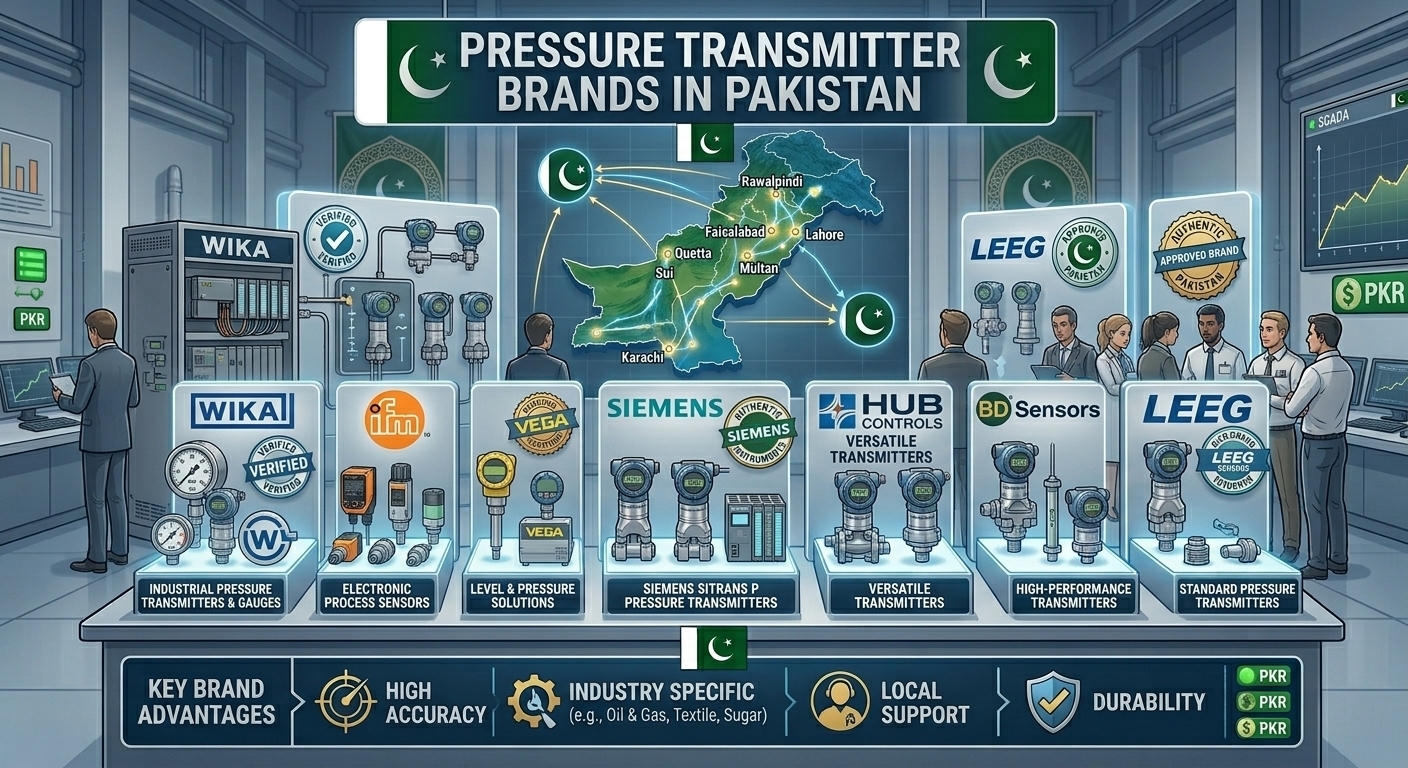
Brand selection is one reason pressure transmitter prices can vary substantially.
PAKCIA's pressure measurement inventory includes international industrial brands and products from different price and performance segments.
These include brands such as WIKA, Endress Hauser, IFM, VEGA, Siemens, Huba Control, LABOM and ECKELMANN, among others.
When comparing brands, consider:
- Manufacturing origin
- Product specifications
- Calibration
- Documentation
- Availability
- Spare parts
- Technical support
- Application suitability
- Warranty
- Long-term reliability
The cheapest transmitter is not necessarily the lowest-cost solution.
If a low-cost transmitter fails repeatedly and causes downtime, the total cost can become much higher than purchasing a reliable instrument initially.
Genuine vs Low-Quality Pressure Transmitters
This is especially important when buying industrial instrumentation in Pakistan.
A pressure transmitter may look similar externally while having very different internal electronics, sensing technology, calibration quality and manufacturing standards.
Before buying, ask for:
- Manufacturer name
- Exact model number
- Datasheet
- Measuring range
- Output signal
- Accuracy specification
- Process connection
- Country of manufacture
- Calibration information where applicable
- Warranty information
Avoid purchasing solely on statements such as:
“Same specification, much cheaper.”
For a critical process, the question is not simply whether the transmitter produces a 4–20 mA signal.
The question is whether it will continue producing the correct 4–20 mA signal under the actual process conditions.
Pressure Transmitter Applications in Pakistan
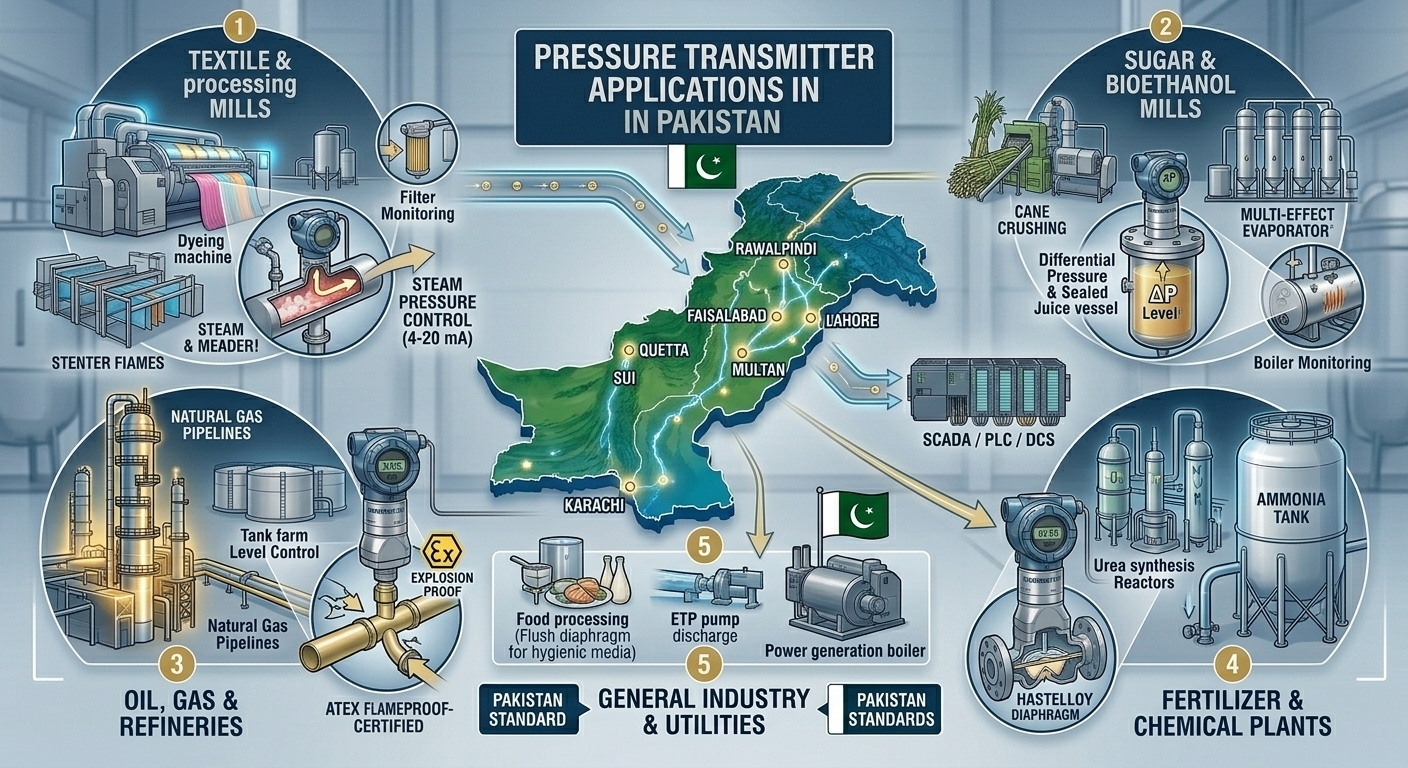
Textile Industry
Pakistan's textile industry uses extensive process equipment involving water, steam, compressed air, pumps and chemical processes.
Pressure transmitters can be used for monitoring pump discharge pressure, compressed air systems, steam-related equipment and process systems.
Water Treatment and RO Plants
Pressure measurement is important in:
- RO systems
- Water treatment plants
- Pumping systems
- Filtration
- Water distribution
- Wastewater treatment
Pressure transmitters can provide continuous pressure feedback to PLC and automation systems.
Boilers and Steam Systems
Pressure measurement is essential in boiler and steam applications.
Depending on the process, instruments may monitor:
- Steam pressure
- Feedwater pressure
- Pump pressure
- Differential pressure
- Process pressure
Correct temperature and pressure ratings are particularly important in these environments.
Chemical Industry
Chemical processes can require careful consideration of pressure, temperature, corrosion, process compatibility and diaphragm materials.
For viscous, contaminated or corrosive media, specialized pressure transmitters may be preferable to conventional pressure sensors.
Pharmaceutical and Food Processing
These industries can require specialized hygienic process connections and materials.
Where contamination or cleaning requirements are critical, a flush diaphragm design may be preferable.
HVAC and Cleanroom Applications
Differential pressure measurement is widely used for:
- Air filters
- Cleanrooms
- Air handling units
- Ventilation systems
- Dust collection
- Building pressure monitoring
For suitable local differential-pressure indication, a Dwyer Magnehelic gauge can be considered.
Pressure Transmitter Price in Pakistan: What Determines the Cost?
There is no universal price because the specification changes from application to application.
1. Brand
European and premium industrial brands can cost more because of manufacturing, quality control, engineering and support.
2. Pressure Range
A low-pressure transmitter and a high-pressure transmitter may have substantially different designs and costs.
3. Accuracy
Higher accuracy can increase the instrument cost.
4. Output
4–20 mA, 0–10 V, HART and other communication or signal options can affect price.
5. Process Connection
Standard threaded connections are generally simpler than specialized process connections.
6. Wetted Materials
Special materials for aggressive media can increase cost.
7. Temperature Rating
High-temperature applications may require specialized designs.
8. Enclosure Protection
Higher environmental protection and specialized housings can influence price.
9. Diaphragm Design
Flush diaphragms and specialized process connections can cost more than standard pressure ports.
10. Availability and Import Costs
In Pakistan, exchange rates, import costs, availability and stock levels can affect final prices.
For this reason, an online price should be treated as a current price indication, not a permanent market price.
Current PAKCIA Pressure Transmitter Examples
| Product | Range | Output | Brand | Listed Price* |
|---|---|---|---|---|
| LEEG Pressure Transmitter | 0–100 bar | 4–20 mA | LEEG | Rs. 22,650 |
| ECKELMANN Pressure Transmitter | Absolute 1–26 bar | 4–20 mA | ECKELMANN | Rs. 32,800 |
| Huba Control Pressure Transmitter | 0–60 bar | 4–20 mA | Huba Control | Rs. 39,500 |
| WIKA Pressure Transmitter | 0–1000 mbar | 0–10 V | WIKA | Rs. 35,800 |
| LABOM CA2100 | 0–6 bar | 4–20 mA | LABOM | Rs. 58,600 |
*Prices are indicative and may change depending on stock availability, exchange rates, import costs and supplier pricing.
Pressure Transmitter Selection Table
| Requirement | What to Check |
|---|---|
| Measurement type | Gauge, absolute or differential |
| Normal pressure | Typical operating pressure |
| Maximum pressure | Highest expected pressure |
| Measuring range | Select suitable span |
| Output | 4–20 mA, 0–10 V, HART etc. |
| Accuracy | Required measurement tolerance |
| Process connection | NPT, G/BSP, diaphragm etc. |
| Wetted material | Compatibility with process medium |
| Process temperature | Maximum and minimum medium temperature |
| Ambient temperature | Installation environment |
| IP rating | Dust and water exposure |
| Supply voltage | Confirm PLC/instrument compatibility |
| Application | Water, air, steam, chemical, hydraulic etc. |
| Brand | Reliability, availability and documentation |
| Budget | Initial cost and total cost of ownership |
Recommended Pressure Measurement Products from PAKCIA
LABOM CA2100 Flush Diaphragm Pressure Transmitter
The LABOM CA2100 is particularly interesting for applications involving viscous, crystallizing or contaminated media because of its front-flush diaphragm design.
The listed model has a 0–6 bar range, 4–20 mA two-wire output, ≤0.2% accuracy and an IP65 stainless-steel case.
View LABOM CA2100 Pressure Transmitter – Price & Specifications
Huba Control 60 Bar Pressure Transmitter
For higher-pressure industrial applications, the Huba Control 60 bar pressure transmitter provides a 0–60 bar measuring range and 4–20 mA output.
The listed configuration uses a 24 V supply and is designed for demanding temperature conditions.
View Huba Control 60 Bar Pressure Transmitter – Price & Specifications
WIKA 1000 mbar Pressure Transmitter
For low-pressure applications, the WIKA 1000 mbar pressure transmitter uses a 0–10 V output and 24 V supply.
View WIKA 1000 mbar Pressure Transmitter – Price in Pakistan
ECKELMANN 26 Bar Pressure Transmitter
The ECKELMANN 26 bar pressure transmitter is specified with an absolute pressure range of 1–26 bar, 4–20 mA output and a 1/4-inch thread.
View ECKELMANN 26 Bar Pressure Transmitter – Price in Pakistan
LEEG 0–100 Bar Pressure Transmitter
For applications requiring a higher 0–100 bar range, PAKCIA offers the LEEG pressure transmitter with a 4–20 mA output.
View LEEG Pressure Transmitter – Price in Pakistan
Digital Pressure Gauge
If your application does not require a PLC or 4–20 mA signal and you simply need local digital pressure indication, a digital pressure gauge may be a better solution.
View Digital Pressure Gauge – Price in Pakistan
Dwyer Magnehelic Differential Pressure Gauge
For suitable low-pressure differential applications such as air handling, filtration and HVAC monitoring, the Dwyer Magnehelic Differential Pressure Gauge can provide local differential-pressure indication.
View Dwyer Magnehelic Differential Pressure Gauge – Price in Pakistan
How to Choose the Right Pressure Transmitter for Your Application
Before requesting a quotation, prepare these specifications:
- What medium are you measuring? Water, air, oil, steam, gas, chemicals or another process medium?
- What is the normal operating pressure? For example, 5 bar, 10 bar, 40 bar or 100 bar.
- What is the maximum pressure? Include pressure spikes where applicable.
- Do you need gauge, absolute or differential pressure?
- What output does your control system require? 4–20 mA, 0–10 V, HART or another signal?
- What is the process temperature? Never assume a standard transmitter is suitable for high-temperature service.
- What process connection do you have? Check both thread size and thread standard.
- What accuracy is required? Do not pay for unnecessary precision, but do not compromise critical process measurements.
- What materials are compatible with the process? Check the wetted parts.
- Where will the transmitter be installed? Indoor, outdoor, wet, dusty, vibrating or chemically aggressive environments require different considerations.
What Is the Best Pressure Transmitter in Pakistan?
There is no single pressure transmitter that is best for every application.
The best pressure transmitter is the one whose measuring range, pressure reference, accuracy, output, process connection, materials, temperature rating and environmental protection match your actual process requirements.
For a standard industrial water, air or hydraulic application, a conventional 4–20 mA pressure transmitter may be the right choice.
For low-pressure applications, a WIKA low-range transmitter may be more appropriate.
For high-pressure systems, a Huba Control or LEEG transmitter with a suitable pressure range may be considered.
For absolute pressure applications, an ECKELMANN configuration may be suitable.
For viscous or contaminated process media, a flush-diaphragm transmitter such as the LABOM CA2100 may provide a better process connection solution.
Where electronic transmission is unnecessary, a digital or mechanical pressure gauge may be the more economical option.
The important point is to select the instrument based on the process—not simply the price.
Get the Right Pressure Transmitter in Pakistan from PAKCIA
PAKCIA provides industrial pressure measurement instruments for applications across Pakistan, including pressure transmitters, pressure sensors, pressure gauges, differential pressure instruments and related process instrumentation.
Instead of choosing a transmitter based only on a product photograph or advertised price, provide your process requirements:
Pressure range + medium + temperature + output + process connection + application
The PAKCIA technical sales team can then help identify a suitable instrument from the available range.
For the latest pressure transmitter price in Pakistan, specifications and availability, explore the PAKCIA pressure measurement range or contact the PAKCIA team directly.
PAKCIA — Pakistan Controls & Industrial Automation
For industrial pressure measurement requirements, choose the instrument according to your process, verify the technical specifications and compare the total value—not just the initial purchase price.
Frequently Asked Questions
What is the price of a pressure transmitter in Pakistan?
Pressure transmitter prices in Pakistan vary according to brand, pressure range, accuracy, output, materials and application. PAKCIA offers pressure transmitters across different price and performance levels. Prices may change depending on availability, exchange rates, import costs and supplier pricing.
Which output is better, 4–20 mA or 0–10 V?
Both can be suitable. 4–20 mA is widely used in industrial automation and PLC systems, while 0–10 V can be suitable where the receiving controller specifically requires a voltage input. Always match the transmitter output to your control system.
What is the difference between gauge and absolute pressure?
Gauge pressure is measured relative to atmospheric pressure, while absolute pressure is measured relative to a vacuum. Gauge pressure is common for water, air and hydraulic applications; absolute pressure is useful where atmospheric-pressure changes must not affect the measurement.
What is a differential pressure transmitter?
A differential pressure transmitter measures the difference between two pressure points. It is commonly used for filter monitoring, HVAC, flow measurement and certain tank-level applications.
How do I select the correct pressure transmitter range?
Determine the normal operating pressure, maximum expected pressure and possible pressure surges. Then select a suitable transmitter range that provides adequate measurement capability without unnecessarily oversizing the range.
Why does pressure transmitter accuracy matter?
Accuracy determines how closely the transmitter's output represents the actual pressure. The required accuracy depends on the importance of the measurement and the process control requirements.
What is a 4–20 mA pressure transmitter?
It is a pressure transmitter that converts the measured pressure into a 4–20 mA electrical signal. This signal can be transmitted to PLCs, DCS systems, SCADA systems and other industrial controllers.
Where can I buy pressure transmitters in Pakistan?
PAKCIA supplies industrial pressure measurement products in Pakistan, including pressure transmitters and pressure sensors from international industrial brands, subject to current stock and availability.
What information should I provide when requesting a pressure transmitter quotation?
Provide the required pressure range, gauge/absolute/differential measurement type, process medium, temperature, output signal, process connection, required accuracy and application. This allows the correct transmitter to be selected instead of simply matching a product by price.
Conclusion
Choosing a pressure transmitter is not simply a matter of finding the lowest pressure transmitter price in Pakistan.
The correct instrument depends on your application, pressure range, measurement type, output signal, accuracy, process connection, wetted materials, temperature and environmental conditions.
By evaluating these factors before purchasing, you can avoid incorrect instrument selection, premature failure and unnecessary costs.
Whether you need a 4–20 mA industrial pressure transmitter, a 0–10 V low-pressure transmitter, an absolute pressure transmitter, a flush-diaphragm transmitter or a local pressure gauge, PAKCIA provides a range of pressure measurement solutions for industrial applications in Pakistan.
Need help selecting a pressure transmitter? Share your pressure range, process medium, temperature, output signal and application with PAKCIA and select the instrument according to your actual process requirements.
Leave a comment